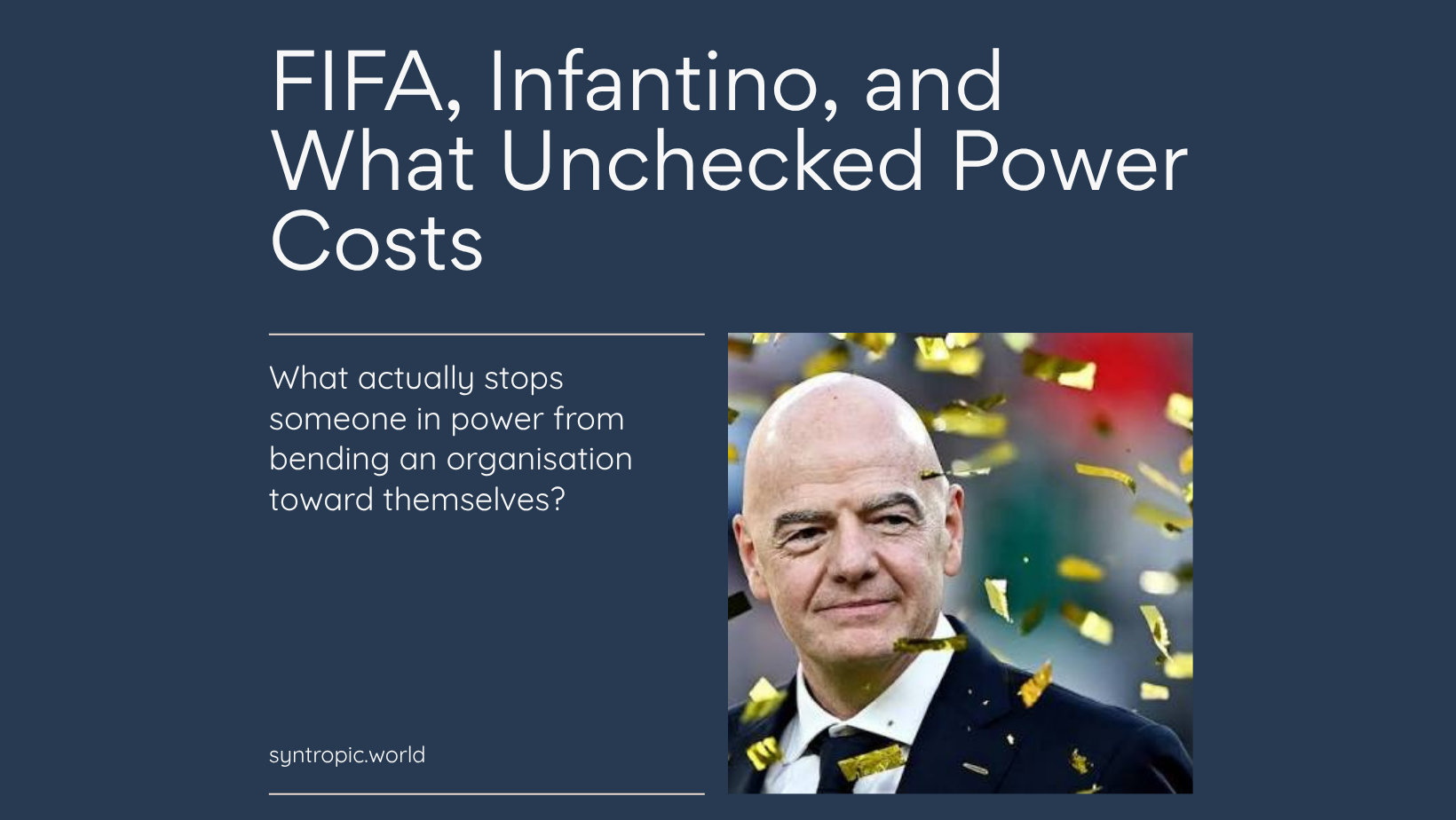
FIFA, Infantino, and What Unchecked Power Costs
Every so often a story breaks that lets you watch a structural failure happen in real time, in public, with a paper trail. FIFA’s aborted sale of a stake in the World Cup is one of those. It is a useful live case for a question every enterprise, not just a football federation, eventually has to answer: what actually stops someone in power from bending an organisation toward themselves?
Context
Days after the 2026 World Cup final, reports revealed that FIFA president Gianni Infantino had quietly negotiated selling a stake in a new entity, FIFA Forward Enterprise, to investors led by Joshua Kushner’s Thrive Capital, seeking up to $4.2 billion at a $20 billion valuation. The deal was never put to a vote of FIFA’s 211 member federations. It was pre-emptively rejected by the European (UEFA), Asian (AFC) and North and Central American (CONCACAF) confederations, some of whom learned key details from press leaks rather than from FIFA itself. UEFA voted unanimously to boycott FIFA competitions unless the plan was dropped. FIFA scrapped it on 1 August, admitting mistakes had been made. UEFA has since said it has “lost confidence” in Infantino, describing the reversal as only the start of “rebuilding trust in FIFA,” and on 4 August served FIFA a legal document preservation letter naming eighteen executives who must retain all relevant records, including Arsene Wenger, now FIFA’s head of global football development, who said he was “not aware” of the plan.
Structural fault
It would be easy to treat this as a one-off misjudgement. It isn’t. The privatisation attempt is the latest in a pattern that has defined most of Infantino’s decade in office. FIFA’s own governance committee recently ruled that his first, partial term (2016 to 2019, completing the remainder of Sepp Blatter’s term after Blatter’s removal) does not count toward FIFA’s three-term limit. That ruling clears him for a fourth term through 2031, fifteen years in office, with the vote scheduled for FIFA’s 77th Congress in Rabat on 18 March 2027. The same tenure has seen FIFA create and award Donald Trump a new “Peace Prize” in December 2025, weeks after Trump was passed over for the actual Nobel Peace Prize, which went to Venezuelan democracy campaigner Maria Corina Machado. It has seen FIFA suspend the automatic one-match ban owed to USMNT player Folarin Balogun after a red card, reportedly following White House intervention, a decision Belgium’s football federation called “incomprehensible” and that prompted Infantino to publicly accuse critics of being “consumed by hate.” And it has seen FIFA award the 2034 World Cup to Saudi Arabia through an uncontested bid process that Human Rights Watch’s Michael Page said meant FIFA had “thrown their human rights policy right in the garbage can,” a decision twenty-one human rights and labour organisations jointly called a “moment of great danger.”
None of these is isolated errors of judgement. They are what happens when an organisation’s checks on power are administered by the office that power belongs to. FIFA’s constitution has a three-term limit; FIFA’s own governance body ruled it doesn’t apply here. FIFA has a human rights policy; FIFA’s own hosting process waived it. The pattern is the finding: power doesn’t announce itself when it goes unchecked, it accumulates quietly, through exemptions an institution keeps granting the very office meant to be limited by them. This is what we call little atrocities, small, specific ruptures of trust, each individually explainable, each treated as a one-off. Enough of them compound, and an organisation stops being able to tell its stated purpose from its president’s preferences.
The Syntropic view
Beneath the stated rationale for the privatisation plan, closing the funding gap for smaller federations, the pattern as a whole was optimising for something else: proximity to power and freedom from constraint, not the health of the game. A synergistic ecology requires the opposite. It requires leadership that exists in service of a purpose larger than itself, structural limits that no office holder, however popular or however long-serving, can waive for their own benefit, and real polarity, protected disagreement, built into governance by design rather than a council that keeps finding technical reasons to extend the exception. The confederations that stopped this deal, UEFA, AFC and CONCACAF, acting independently and publicly, are what functioning dissent looks like when a system allows it. It should not require three confederations threatening boycott and litigation to do what a properly designed governance structure should do as a matter of course.
Syntropic application
The Syntropic starting point here is not a communications fix. It is returning FIFA to its founding purpose and its Pattern Integrity, the idea, going back over a century to the organisation’s founding in 1904, that the game belongs to those who play and follow it, not to whoever currently holds the presidency. From there, the work is architectural. Term limits need to be enforced by a body genuinely independent of the president’s influence, not one whose rulings the president benefits from. Finances need to be published and auditable by any member federation, not only summarised in a report. Any commercial restructuring or hosting decision needs to require member ratification before negotiations begin, not after a leak forces an emergency vote. Support needs to be weighted deliberately toward the smaller and poorer federations the game depends on, rather than toward whichever deal keeps the largest confederations quiet. And leadership needs to be elected through a process that rewards stewardship, not proximity to the most powerful people in the room.
Stewardship, in this context, has a specific shape. Stewards are paid well for the responsibility they carry, never obscenely, and they are people who love the game itself more than the money or the influence that surrounds it. That is a testable design principle, not a slogan: you can build governance structures that select for it, and you can build governance structures, like the one FIFA currently has, that quietly select against it.
Proof, not promises
Success is not a smoother statement next time. It looks like a term limit no committee can waive on the office holder’s behalf. It looks like finances any federation, however small, can actually audit. It looks like a hosting or investment decision that survives real scrutiny from members before it is signed, not after it has already leaked. It looks like a president who invites early, structural scrutiny because the outcome gets better for having survived it, rather than one who tightens the circle to keep it from leaking in the first place.
Boundary
This is not a call for a better ceremony, a warmer statement, or a more emollient spokesperson. A defence of FIFA’s leadership that does not touch who holds power, for how long, and who is actually able to check them, is theatre performed over an unchanged structure. If what an organisation wants is control dressed up as reform, this approach is not for them.
Questions worth sitting with
If you lead an organisation of any size, three questions are worth asking honestly. Can anyone in power waive the limits meant to constrain them, and who actually stops them if they try? Does dissent reach the table while a decision is still being shaped, or only after it has already been decided? And is your leadership serving the purpose the organisation exists for, or has the purpose quietly become whatever leadership currently needs it to be?
Sources
- Al Jazeera, “UEFA’s threatened legal action against Infantino and FIFA: What we know,” 4 August 2026
- Al Jazeera, “UEFA confirms legal letter served to FIFA after Infantino’s World Cup plan,” 4 August 2026
- Al Jazeera, “UEFA welcomes FIFA World Cup standdown after voting to boycott,” 1 August 2026
- Al Jazeera, “FIFA World Cup fallout: Infantino scraps private investment plan,” 31 July 2026
- Axios (Dan Primack), “FIFA ends its big private equity plans,” 3 August 2026
- CNN, “European soccer body UEFA warns FIFA of legal action over Infantino’s failed World Cup sell-off plan,” 3 August 2026
- ESPN, “UEFA vows World Cup boycott as Concacaf, AFC reject FIFA private equity plan”
- Inside the Games, “Infantino could lead FIFA until 2031 as Council says first 39 months did not count towards term limits”
- Al Jazeera, “Africa and Asia back Infantino for unique fourth term as FIFA president,” 30 April 2026
- AOL/PA, “Donald Trump awarded controversial Fifa Peace Prize by Gianni Infantino at World Cup 2026 draw”
- Wikipedia, “2026 Trump-FIFA red card controversy”
- Al Jazeera, “FIFA’s Infantino issues letter, accuses World Cup critics of spreading hate,” 27 July 2026
- theScore, “Human rights groups fear Saudi World Cup will cause unprecedented damage”