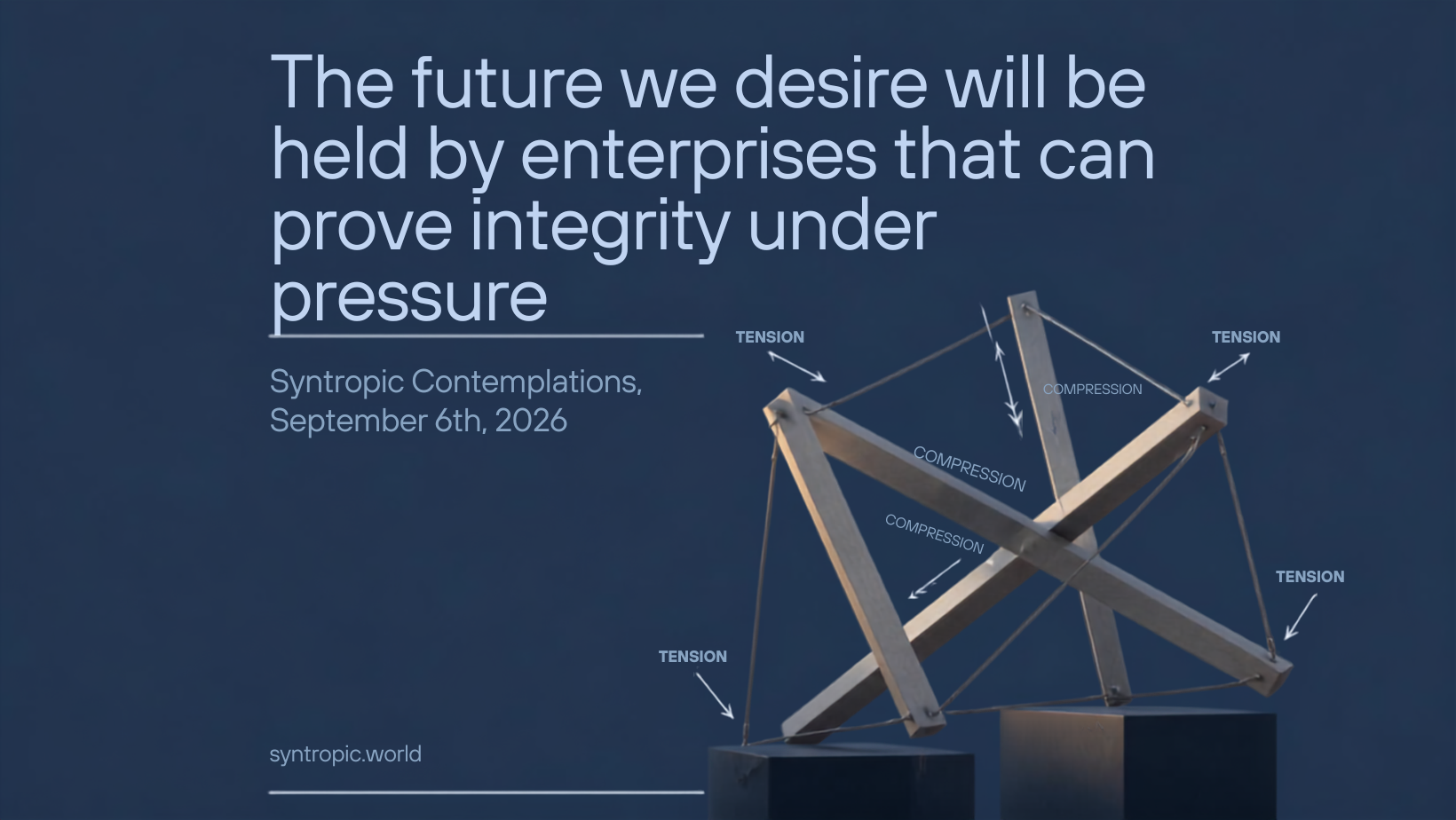
The future we desire will be held by enterprises that can prove integrity under pressure
If trust only appears in the conversation after it has been broken, it was never designed.
For too long, enterprises have treated trust as a feeling. A value statement. A brand promise. A culture workshop. A repair job after the harm has already moved through the system.
That era needs to end.
Trust is not a sentiment. Trust is not a leadership slogan. Trust is not something we invoke once conflict, politics, silence, extraction, or betrayal have already taken root.
I refuse trust as branding or workshop theatre. I refuse trust as a word placed on the wall while money, power, conflict, incentives, and accountability remain untouched.
Trust is not declared. Trust is designed.
It is designed into agreements. It is designed into communication. It is designed into governance. It is designed into timing, money, decision-making, accountability, and consequence.
Any enterprise that does not design trust before pressure arrives will default to the operating system it has not examined: protection, extraction, avoidance, performance, politics, or collapse.
This is not because people are bad. It is because most enterprises were never built to hold the truth when the stakes rise.
Design the agreements before the conflict. Clean the charge before it becomes culture. Make power visible before it becomes abuse. Align incentives before they corrupt purpose. Practice truth before crisis demands it.
This is the work beneath the work.
Not the soft work. Not the optional work. Not the nice-to-have human layer added after strategy, finance, governance, and growth have already been decided.
Trust is infrastructure.
It is the architecture that determines whether purpose survives contact with pressure. It is the condition that allows intelligence to move through a system without distortion. It is the field in which people can tell the truth early enough for the enterprise to remain clean.
The future will not be held by enterprises that perform integrity. It will be held by enterprises that can prove integrity under pressure.
For the leaders who are done with cosmetic change, this is the invitation:
Stop declaring trust. Start designing it.
Build enterprises that are harder to corrupt. Build systems where dignity is not dependent on personality. Build cultures where truth does not require crisis to be spoken. Build agreements strong enough to hold money, power, conflict, purpose, skill, time, energy, values, alignment, and coherence.
Trust is not the soft work.
Trust is the infrastructure that decides whether the future will hold in integrity, or without it, in decay.
If you missed the first part of this sequence, you can find Part 1 here.