On the Conditions That Make People Whole
THE MACHINE MODEL
There is a particular kind of enterprise that produces diminished people. It calls itself efficient. It calls itself modern. It optimises, extracts, measures and ranks. It sorts people into roles and compensates them in a single domain, while the rest of what they are goes unseen, unaccounted for and unrewarded. It mistakes the person for the function. It mistakes compliance for contribution.
This is not accidental. A diminished person is easier to manage.
People do not diminish on their own. They are diminished. Made smaller by the conditions in which they are placed. Economic precarity. The increased use of screens and AI that isolate. Relational fragmentation. The slow erosion of any shared world in which a person can be known, held and real to others.
This is the machine model of the enterprise. And it is everywhere.
DESIGNED PRECARITY
And the conditions that create precarity are not neutral. They are designed. Not through conspiracy but through structure. The legal codes that govern employment and create power and knowledge asymmetries, the institutional frameworks that determine who holds power and who is exposed, the tax systems that reward the accumulation of capital over the contribution of labour, the governance systems that protect existing arrangements against challenge, all of these work together to make insecurity a design feature, not a failure.
Precarity is built in. It is the operating condition that keeps people available to instruction, too stretched to refuse, too exhausted to imagine otherwise.
The enterprise, community, society, that runs on a single domain, on currency alone, produces exactly this. It produces people who cannot see a future. Who cannot refuse. Who cannot act from loyalty to something larger than survival. Who experience the flourishing of others not as connected to their own, but as a threat to it.
The incumbent system runs on game theory logic. Some people call it Moloch. It places individuals inside conditions of scarcity and competition, then watches defection, hoarding and withdrawal become the rational response. And because everyone acts from that assumption, the assumption becomes true. The system does not need to force this outcome. It only needs to sustain the conditions that make it feel inevitable.
THE SYNTROPIC RESPONSE
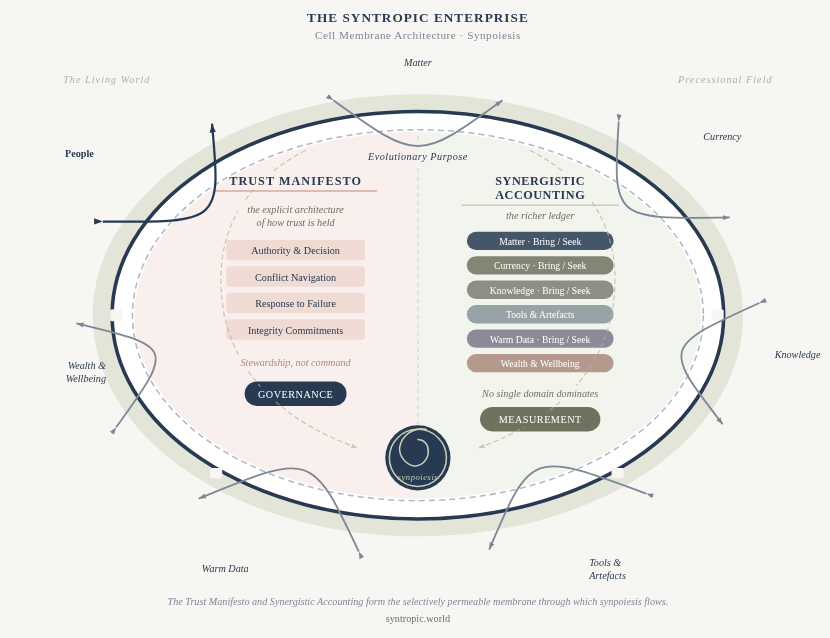
A Syntropic Enterprise begins from a different premise entirely. It begins with the recognition that a person is not a unit. A person is a full spectrum of intelligence, care, judgment, relationship, knowledge, experience and embodied knowing. Synergistic Accounting exists precisely to make this visible. Not because it is a nice idea, but because ignoring it is ruinously expensive. Synergistic Accounting considers the whole contribution, in six domains of input and six domains of output, one domain of which is money.
When only currency is counted, the other five domains go unmet. When the other five domains go unmet, people break. They break through financial precarity, through lack of empathy and care, through lack of access, knowledge and the necessary tools and technology. They break because they are exploited, marginalised, and dehumanised. When people break, they stop trusting. When trust is gone, collaboration becomes strategy, forced upon people without agency. When collaboration becomes strategy, you are no longer building something alive. You are managing something dying.
Synpoiesis is the answer to this. Not as a concept but as a practice. Synpoiesis is the result of designing ecologies where we become better in all domains as we do our work, live our lives and create a future. The whole architecture of a Syntropic Enterprise, the Trust Manifesto and Synergistic Accounting together, exists to create the conditions under which people can live and work from their full humanity. Where an individual does not have to break in order to survive. Where the full range of contribution is seen and reciprocated. Where the future is real enough to act for. Where trust is not naive but architected.
THE ARCHITECTURE OF TRUST AND VALUE
The Trust Manifesto is not a values document. It is an explicit living structure of how trust is held, how authority works, how conflict is navigated, how failure is met. It creates continuity. It creates the shared world in which people can be more than strategic units. It restores the sense and knowing that one’s actions belong to a longer arc than immediate survival.
Synergistic Accounting restores relational architecture. It refuses the reduction of a person to a single domain. It says: you are more than what you are paid for. You bring knowledge, tools, relational warmth, embodied wisdom, material care, and the wealth of your own deep flourishing. And we will see all of it. We will account for all of it. We will design exchanges around all of it.
This is not idealism. It is the precise structural correction to the incumbent system.
THE TASK
The task is to rebuild the conditions under which cooperation becomes liveable again. That is exactly what a Syntropic Enterprise is. It is the organisational form that makes full human flourishing liveable. Not through exhortation. Not through asking people to be better while keeping them precarious. But through architecture. Through governance. Through accountability. Through the genuine accounting of what people bring and what they need.
When people are diminished, collapse feels rational. When people are whole, another future becomes possible.
A Syntropic Enterprise is not just good business. It refuses the logic of the incumbent, Molochian system. It is the refusal to keep producing broken people, and to keep them broken. It is the insistence that the conditions of trust, dignity, futurity and full contribution can be designed, not merely wished for.
That is the work. And it has always been the work.