Bringing Forth Together: Synpoiesis and the Architecture of the Economy We Need
The dominant economic model has a design flaw. Not a management problem, not a values problem, but a structural design problem. It was built on these three assumptions: that resources can be drawn continuously on a finite planet; that what gets externalised like air quality, waste, land degradation, human slavery, for example, can be deferred indefinitely; and that the world into which outputs are released will remain intact enough to absorb them. None of these assumptions now hold.
The harm our enterprises produce is not an aberration. It is the predictable result of a design that cannot regenerate the conditions on which it depends.
What is emerging is not a correction to this model. It is a different model. We are moving from an economy organised around the efficiency of converting resources into products and services, to one organised around recursive developmental capacity. The ability of a system to learn through each cycle of activity, deepen its own conditions of performance, and become more capable over time.
This is not new thinking in Syntropic World. It is the territory we have been working in and working to make structurally actionable for twenty years.
What recursive actually means in practice. Compounding capacity, awareness and synergy.
A recursive system does not simply produce outputs and reset. Each cycle informs the next. The regenerative farm builds soil health, water retention, and farmer judgment across seasons, value that compounds. The manufacturing system shortens its own feedback loops, improving the means of production. The enterprise learns its way into better decisions with people who become more whole as they contribute to the enterprise purpose.
The difference, in practice, is between an organisation that manages and one that develops, evolves and emerges. Between one that executes a plan and one that grows its own capacity to create better plans, better people and better ecologies.
Learning velocity, the speed and quality with which a system can register what is happening, interpret it honestly, and adjust, becomes one of the most important economic capacities an enterprise can possess. Not innovation as aspiration. Adaptive capacity as structural design. Humans who grow up, embody wisdom, and become more coherent as they do the work of the enterprise.
The problem is design. The tools are design tools.
A Syntropic Enterprise cannot be produced by better management of the existing model. It requires a different architecture, built from different ground, on different principles, with different tools.
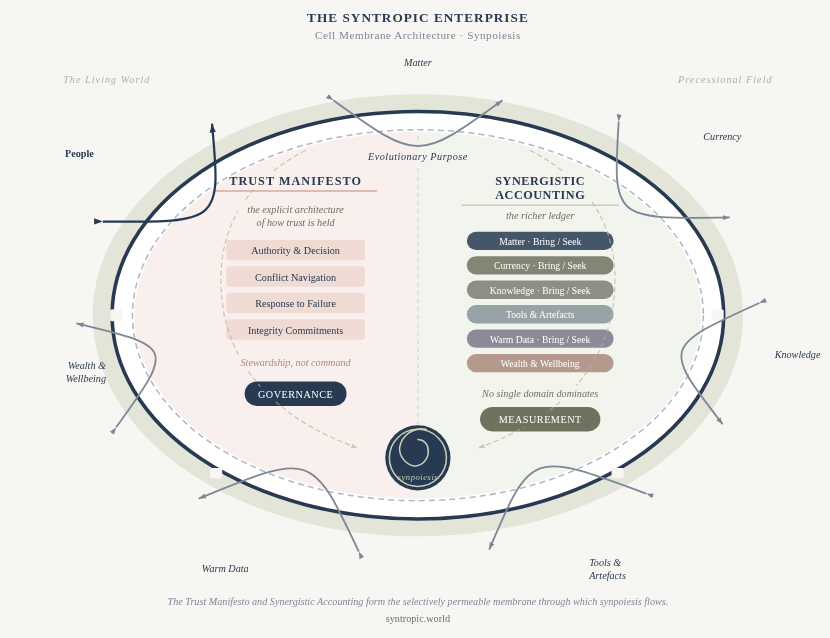
Two primary tools form what I think of as the cell membrane of that architecture: the Trust Manifesto and Synergistic Accounting.
The cell membrane is the right metaphor. It is not a wall. It is a selectively permeable structure that maintains the integrity of a living system while enabling the exchange on which life depends. It holds coherence without closing. It allows growth without losing form. It is a living demonstration of polarity as essential to existence. It allows flow and prevents attack.
What happens through this architecture is what I call synpoiesis – a bringing forth together. Where autopoiesis describes a system that produces and sustains itself, synpoiesis names something more fundamental to a Syntropic Enterprise: the recursive, regenerative capacity to bring forth something new in genuine relationship- with people, with the living world, with the future the enterprise is helping to create. Synpoiesis is not self-production. It is co-creation that compounds. It is the mechanism by which a Syntropic Enterprise becomes more capable, more generative, and more alive through each cycle of its work- not despite its relationships and dependencies, but because of them.
A Syntropic Enterprise is relational in all things.
Synpoiesis is the recursive regenerative design feature of a Syntropic Enterprise. It does not happen by accident. It requires the right thoughtfully considered architecture.
The Trust Manifesto provides that architecture. It is not a mission statement, a values poster, or a compliance document. It is the explicit structure of how the enterprise holds trust: the agreements governing how decisions are made, how authority is exercised, how conflict is navigated, how the enterprise responds to pressure and to failure. It makes visible what is usually invisible- the implicit contracts that either sustain or erode the conditions for genuine collaboration.
This is what governance must become in a recursive system. Not the enforcement of a predetermined plan, but the stewardship of conditions in which the enterprise can learn, revise, and adapt without losing integrity. The Trust Manifesto is recursive by design. It is not fixed. It is the framework within which an enterprise can change itself, deliberately, not by drift, while remaining coherent. It is the membrane through which synpoiesis becomes possible: the structure that holds the enterprise open to genuine relationship without losing its form.
Synergistic Accounting is the richer ledger, and the other half of the membrane.
A recursive system requires new forms of measurement, because not all value appears in immediate metrics. Capital allocated to sensing, learning, coordination, human relational engagement and regeneration is treated as overhead in conventional finance. In a Syntropic Enterprise, it is recognised as central productive capacity, the substrate on which all other value depends.
Synergistic Accounting names this with precision. It accounts for value across six domains: Matter, Currency, Knowledge, Tools & Artefacts, Warm Data, and Wealth & Wellbeing. Each domain has two directions: what is brought or contributed, and what is needed or expected. This is not a softer version of the P&L. It is a structurally different map of what an enterprise actually runs on, and what it is actually building or consuming.
With this ledger, an enterprise can see what the conventional model renders invisible: the vitality of people being cultivated or depleted, the depth of relational capital being built or eroded, the quality of know-how accumulating across cycles. It can see, before the financial signals arrive, whether synpoiesis is genuinely occurring, whether the enterprise is compounding developmental capacity together, or whether it is consuming or extracting from the very substrate it depends on and moving into entropy.
Together, the Trust Manifesto and Synergistic Accounting create the conditions in which synpoiesis can happen structurally, not just aspirationally. They are not soft tools. They are the design infrastructure of an enterprise built to bring forth something new, together, across time.
The implications for funding and capital
Capital allocation must shift from “what will this produce?” to “what will this make possible in multiple domains across many fields (precession)?” This requires patience, because developmental value compounds across cycles rather than appearing instantly. It requires new evaluation frameworks, ones capable of seeing value that does not show up in quarterly output metrics. The weightless, invisible metrics of love, care, respect, culture, art and community. It requires new institutional forms, because few existing structures are designed to hold and govern this kind of value.
The Syntropic Enterprise framework speaks directly to this.
A Syntropic Enterprise is built on Evolutionary Purpose– the genuine answer to what the enterprise exists to do, for whom, and what conditions it is committed to leaving better. This is not a strategic narrative deployed for pitch decks. It is the gravitational centre that makes long-term, patient capital coherent. An investor who understands Evolutionary Purpose is not investing in outputs. They are investing in a developmental arc- in the ongoing synpoietic capacity of an enterprise to learn, adapt, and leave its world genuinely better. Often in ways unpredictable at the outset. Emergence is embraced.
Synergistic Accounting changes what returns look like. When a funder can see that an enterprise is building know-how, deepening relational capital, maintaining the vitality of its people, and expanding its adaptive capacity, they have visibility into the real productive substrate, the precessional field effects of the enterprise, not just the quarterly number. They can see whether synpoiesis is occurring: whether the enterprise is genuinely becoming more capable together, or quietly spending down the conditions of its own future. This is the measurement infrastructure that recursive finance requires. Not a replacement for financial returns, but the context within which financial returns can be honestly understood.
The Trust Manifesto changes what governance looks like. When founders, stewards, and funders operate within a shared architecture of trust- explicit agreements about how authority is held, how the enterprise responds when things go wrong, what the enterprise will not compromise on regardless of pressure- governance becomes less about control and more about the conditions of synpoietic coherence – which we call Stewardship. The enterprise can be held accountable without being rigidified. It can be revised without being destabilised. It can bring forth something genuinely new, together, without losing its integrity in the process.
The deeper shift
Value does not live at the point of exchange. It lives in the capacity of the enterprise to learn, regenerate, and bring forth something new together- precessionally, across time, with everyone it touches.
The conventional model cannot see this value. Its ledger is too narrow. Its governance is too brittle. Its investment logic is too impatient. It optimises for outputs and returns while consuming the substrate on which the returns depend. It is designed for short-term gains without consideration of accounting for the future.
A Syntropic Enterprise – a Beautiful Business – is designed differently from the ground up. Synpoiesis is not an aspiration layered on top of a conventional structure. It is the structural logic of the enterprise itself: the recursive, regenerative capacity to bring forth together, encoded into the architecture of trust and the accounting of value.
The economics of the future will be defined by how well we can design, finance, and govern systems of becoming. Creating life-enhancing human economies. The Trust Manifesto and Synergistic Accounting are not metaphors for this shift. They are the structural tools through which synpoiesis is made possible, measurable, and investable.
The question is no longer only what an enterprise produces. It is what the enterprise is becoming capable of bringing forth, the many possible field effects and ripples in expected and unexpected domains- with people working together synergistically, and over time.
And whether the architecture it is built on creates this possibility of becoming.
May 2026